









The final vaccine construct for Rose was designed by Grok
— Paul S. Conyngham (@paul_conyngham) March 15, 2026
Paul Conyngham didn’t use just ChatGPT to build a personalized cancer vaccine for his dog Rose. Most headlines say he did, and several major outlets covering the story didn’t mention Grok at all. Conyngham himself has since clarified that Grok designed the actual final mRNA construct. ChatGPT was part of the research and planning phase. Grok did the molecular work that mattered most.
Here’s a screenshot of some of the headlines from top articles that only mention ChatGPT in their coverage.
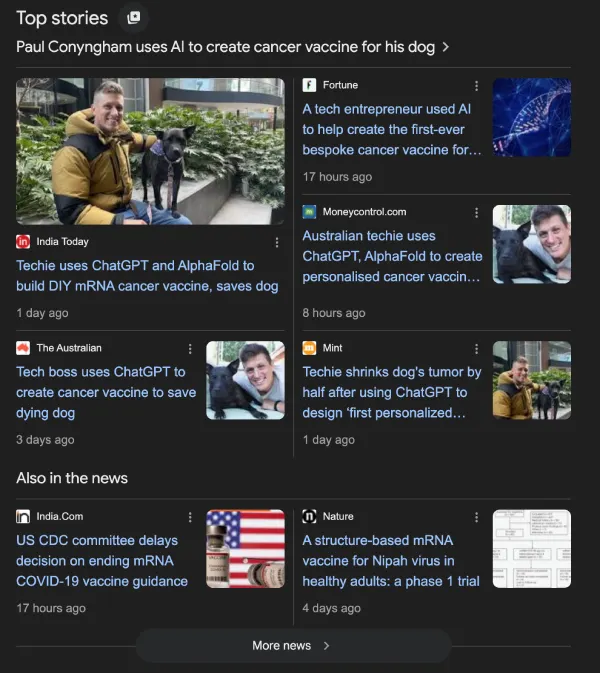
This story went viral pretty quickly. Conyngham, an Australian tech consultant with no background in biology, paid $3,000 to sequence Rose’s tumor DNA after vets gave her between one and six months to live. He fed the data into ChatGPT to map out a treatment approach, then used Google DeepMind’s AlphaFold to model the mutated proteins.
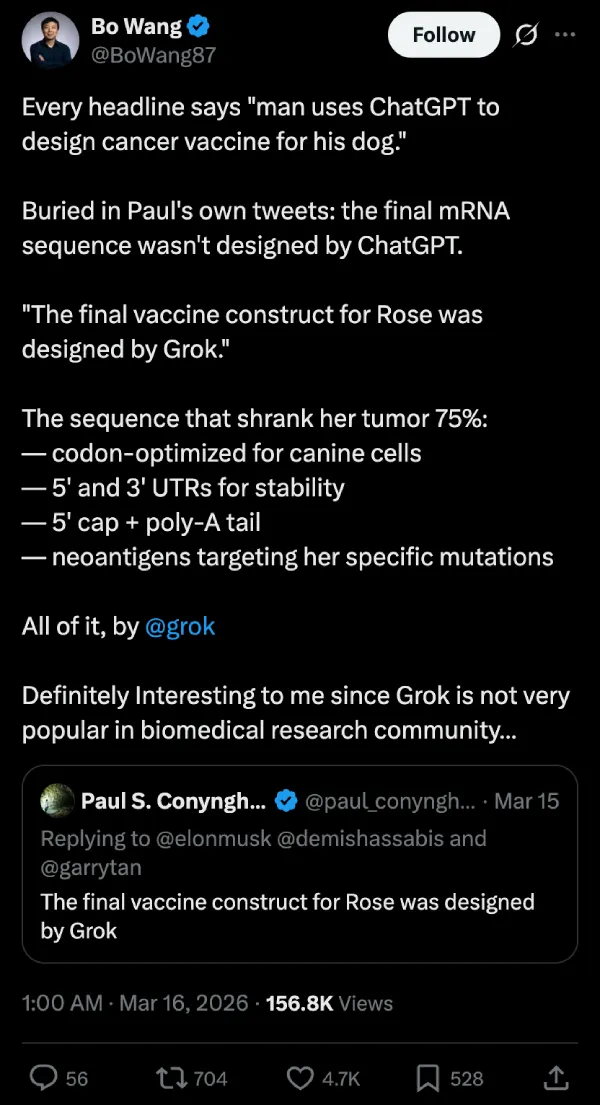
After that, he handed the design work to Grok, which produced a codon-optimized mRNA sequence targeting Rose’s specific tumor mutations, complete with 5′ and 3′ UTRs for stability, a 5′ cap, and a poly-A tail. UNSW synthesized the vaccine and began administering it in December 2025.
By January, the results looked genuinely remarkable. Photos Conyngham posted show Rose’s leg before and after treatment. In early December, her ankle was barely recognizable, a swollen, uniform cylinder with fluid retention completely obscuring the underlying bone and muscle structure. By late January, the Achilles tendon was visible again. The tumors had flattened and turned grey. Conyngham says tumor volume dropped roughly 75 percent.
— Paul S. Conyngham (@paul_conyngham) March 14, 2026
Now, several people are highlighting how major news outlets simply skipped mentioning Grok. Researcher Bo Wang noted that the sequence, which apparently shrank Rose’s tumors, wasn’t ChatGPT’s work at all, and pointed out that Grok is not a common tool in the biomedical research community.
It’s worth noting, however, that the vaccine was co-administered with an existing anticancer drug, which makes it genuinely difficult to attribute the outcome to the mRNA construct alone.
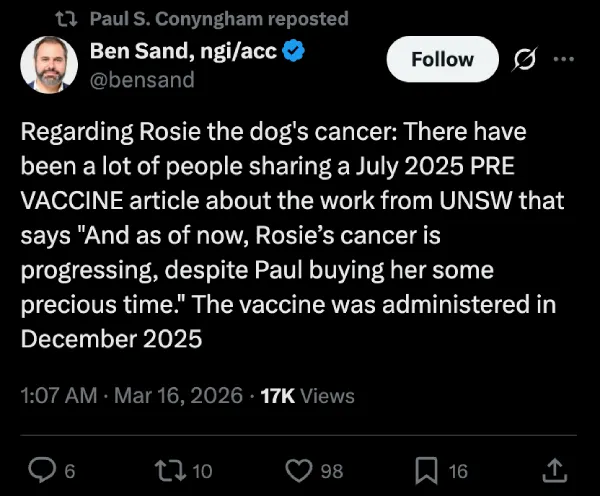
Some reports even cite a June 2025 UNSW article noting that, despite Paul’s efforts, the cancer is still progressing. However, the fact is that the vaccine campaign (treatment) didn’t begin until December 2025, as noted by @bensand, whose post got reposted by Paul.
What the story does show pretty clearly is that Conyngham ran three different AI tools across three distinct phases of the same medical problem. ChatGPT for research, AlphaFold for structural modeling, Grok for the final construct. The credits matter, and most of the coverage got them wrong.
Featured image generated with AI
TechIssuesToday primarily focuses on publishing 'breaking' or 'exclusive' tech news. This means, we are usually the first news website on the whole Internet to highlight the topics we cover daily. So far, our stories have been picked up by many mainstream technology publications like The Verge, Macrumors, Forbes, etc. To know more, head here.



Dwayne Cubbins
1444 Posts
For nearly a decade, I've been deciphering the complexities of the tech world, with a particular passion for helping users navigate the ever-changing tech landscape. From crafting in-depth guides that unlock your phone's hidden potential to uncovering and explaining the latest bugs and glitches, I make sure you get the most out of your devices. And yes, you might occasionally find me ranting about some truly frustrating tech mishaps.


Comments
Follow Us

