


Starlink customers across the US are getting emails saying their monthly bill will rise 10% or 20%, not because of inflation or a new feature, but because of how many people near them use Starlink. For anyone on Residential Max, the top-tier plan, a 20% increase takes the bill from $130 to $156 a month, which adds $312 a year.
Others got the opposite email: lower bills in parts of the Midwest, and half off for new customers in cities like Boston. I went through the customer emails, Starlink’s terms, and five years of its pricing changes to work out what’s going on and what you can do.
Where did this start, and how far has it spread?
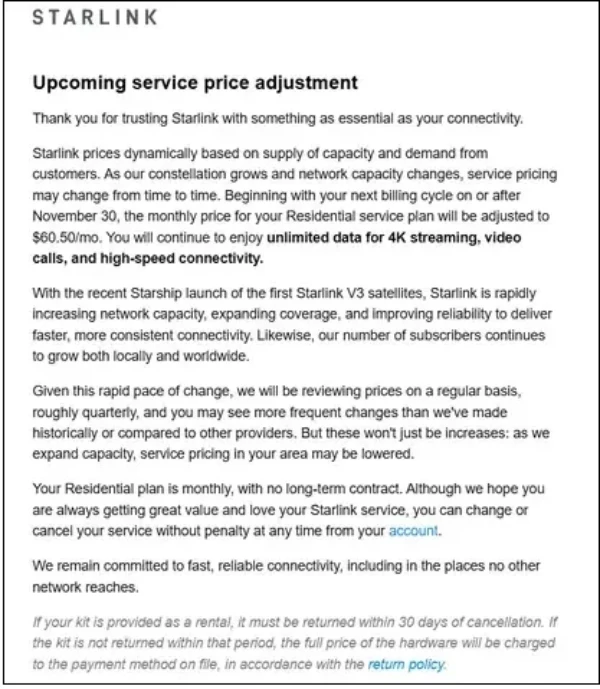
PCMag first reported on October 29 that SpaceX had emailed Residential customers in parts of Kansas and Missouri about “dynamic pricing.” Here’s what the email:
Given this rapid pace of change, we will be reviewing prices on a regular basis, roughly quarterly, and you may see more frequent changes than we’ve made historically or compared to other providers. But these won’t just be increases: as we expand capacity, service pricing in your area may be lowered.
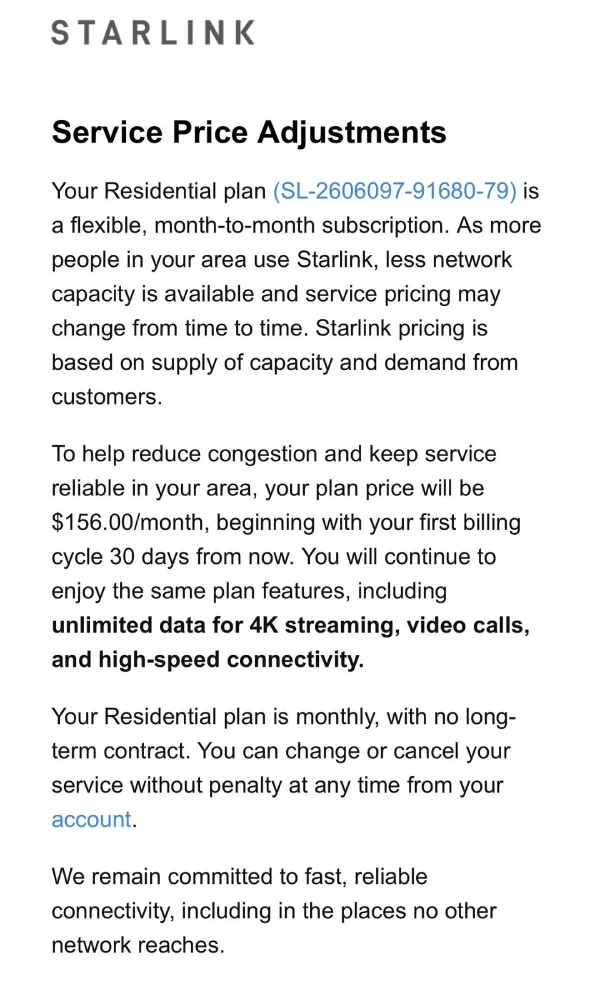
Now, after checking the r/Starlink subreddit, it looks like this has gone nationwide. Customers from Virginia to Alaska reported notices, and Starlink.com shows 20% higher prices in places like Portland, Oregon; Spokane, Washington; and Lafayette, Louisiana. The newer email drops the “quarterly” language and says only this:
As more people in your area use Starlink, less network capacity is available and service pricing may change from time to time.
Here’s a screenshot of the email shared by u/Suspicious_Royal8951:
SpaceX hasn’t commented, and I found nothing from Starlink or Elon Musk on X explaining it.
What will you actually pay?
The reported prices follow a neat pattern: the plan’s standard price (set in May at $55, $85, and $130) times a fixed step of 0.8, 0.9, 1.1, or 1.2 (the new-customer discounts use 0.7 and 0.5). PCMag found code on Starlink’s site suggesting a 20% cap either way. That gives you this:
Reported prices line up with it: Marysville, Kansas at -20%, Kansas City at -10%, Warsaw, Missouri at $143, and Rolla, Missouri at $156. The 50% new-customer discount in Boston puts Max at $65. So a Max customer in a crowded area pays $1,872 a year, while a new one in Boston pays $780 for the same plan.
Haven’t we been here before?
The answer to that is a simple yes. This is the boldest version of something Starlink has done since 2023.
- Launch: $99 a month plus $499 for the dish.
- March 2022: $110 and $599, blamed on inflation.
- February 2023: The first split by location: $120 in “limited capacity” areas, $90 in “excess capacity” ones.
- September 2024: A one-time $100 “congestion charge” for new sign-ups in crowded areas.
- 2025: Renamed a “demand surcharge,” it hit $1,000 by June in parts of the Pacific Northwest, including Spokane and around Portland, two places now showing the +20% rate.
- January 2026: New lineup: 100 Mbps ($50), 200 Mbps ($80, replacing Residential Lite) and Max ($120).
- May 2026: Increases of $5 to $10 brought those to $55, $85, and $130.
The difference now is who pays. Surcharges mostly hit newcomers. Dynamic pricing changes the bill for people who already own the hardware, and in congested areas it’s the second increase this year. Against the original $99, a $156 bill is about 58% higher.
Why is Starlink doing this?
Well, it looks like they’re having capacity issues, which could be part of the problem. A satellite network can only deliver so much bandwidth to one patch of ground, and every new household there takes a slice. Starlink has managed that with waitlists, surcharges, and now monthly prices.
Another potential reason for the changes is the company’s revenue. PCMag reports Starlink’s average revenue per user fell from $83 a month to $69 over the past year, across 13.6 million consumer subscribers. Satellite analyst Tim Farrar neatly summed up the strategy: lower prices where Starlink competes with cable and fiber, and raise them “in high demand (uncompetitive) areas” so “ARPUs should go up.”
Here’s my two cents:
The capacity argument is real, but this is also a pricing strategy. The congested areas are often rural places with little competition, where customers have the least leverage. As one Missouri subscriber told PCMag, “a 20% increase in 10 months is not sustainable.” Former FCC chief technologist Jon Peha said he’d never seen an ISP change prices for existing customers on a quarterly basis.
What can you do if your bill is going up?
This is where you should pay close attention. I’ve listed out a few key things you can do if you don’t want to end up paying a pretty penny for Starlink.
- Read the email for the effective date: Starlink’s terms require at least 30 days’ notice of “materially adverse changes” and a summary of your right to cancel. The first notices took effect on the billing cycle on or after November 30.
- Check your address on Starlink.com: Checkout shows your local price. On Max, see whether 100 Mbps or 200 Mbps is offered where you live, since those plans move by the same percentage from a lower base. At least one Max customer told PCMag he had no option to switch, so check first.
- Look at the alternatives honestly: The FCC’s National Broadband Map lists the providers that claim service at your address, including 5G home internet and fiber that may have arrived since you signed up. In the Reddit discussion, people who’d used Viasat and HughesNet called them worse on latency and data caps, while others said rural co-ops are laying fiber nearby.
- Know the exit rules: Month-to-month plans can be canceled anytime from your account with no fee; do it before your next invoice is generated. If you took a 12-month commitment for a free dish, read the terms first, because changing or canceling during that period can trigger a change fee. Rented kits must be returned within 30 days of canceling.
- Don’t wait for Amazon: Amazon Leo says it will start initial service in 2026, but it hasn’t announced US consumer pricing or availability yet.
That said, there’s still one open question I couldn’t answer: SpaceX said in June its $55 plan would be available to eligible subscribers in areas where it won federal BEAD broadband money. Nothing I found says whether those homes are exempt from dynamic pricing.
If your email says your price is going down, enjoy it, but don’t count on it being permanent. Starlink’s own wording says the price can move “from time to time,” and the next adjustment could go either way.
TechIssuesToday primarily focuses on publishing 'breaking' or 'exclusive' tech news. This means, we are usually the first news website on the whole Internet to highlight the topics we cover daily. So far, our stories have been picked up by many mainstream technology publications like The Verge, Macrumors, Forbes, etc. To know more, head here.



Dwayne Cubbins
1487 Posts
For nearly a decade, I've been deciphering the complexities of the tech world, with a particular passion for helping users navigate the ever-changing tech landscape. From crafting in-depth guides that unlock your phone's hidden potential to uncovering and explaining the latest bugs and glitches, I make sure you get the most out of your devices. And yes, you might occasionally find me ranting about some truly frustrating tech mishaps.


Follow Us

