


On Tuesday, The New York Times reported that Google will disable its AI tools for K-12 student accounts early next year unless a school re-enables them. But there’s a catch: a school that blocks AI entirely will also lose student access to Google Search.
Chris Phillips, Google’s VP for education, put it bluntly to the Times: “Search and A.I. are deeply integrated.” If a school bans AI, he said, students “will not have access to search, and they’ll see a message from their school that indicates it’s not available.”
What exactly is Google changing for schools?
Google’s own announcement frames it as a move toward more control:
Access to these products will be entirely off for K-12 student accounts until school administrators explicitly turn them on.
“These products” are Gemini, Gemini Notebook, Gemini in Classroom, and Google Search. Search is on that list because, for student accounts, Search now comes with AI Overviews and AI Mode. Google is also bringing Guided Learning, a Gemini feature that coaches students step by step instead of handing them answers, to Search and Classroom.
Per the Times, districts that allow AI will get two choices starting in early 2027: Search with AI Overviews and AI chat turned on, much like what you and I see at home, or Search built around Guided Learning. There’s no third option for plain Search without AI.
Why are parents and schools so upset?
This comes down to the fact that the country’s two largest districts, New York City and Los Angeles, both Google customers, restricted student access to generative AI on school devices in September. Los Angeles officials told the Times they’d hoped students could keep searching with AI Overviews switched off.
New York City Mayor Zohran Mamdani responded on social media: “No corporation should have the power to dictate how we teach our children.” Former FTC chair Lina Khan went further and accused Google of using its “search monopoly to coerce schools.”
What does Google say?
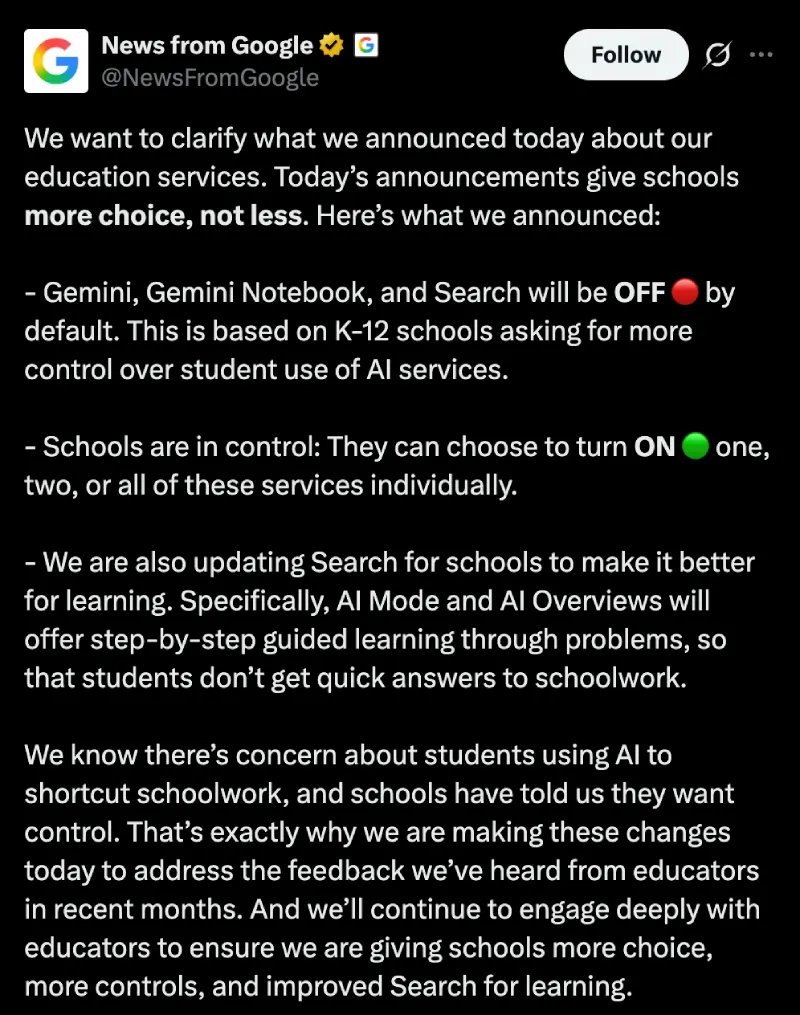
After the backlash, Google posted a clarification on X:
Today’s announcements give schools more choice, not less… Gemini, Gemini Notebook, and Search will be OFF by default. This is based on K-12 schools asking for more control over student use of AI services.
Google added that schools can switch on “one, two, or all of these services individually,” and that AI Mode and AI Overviews for schools “will offer step-by-step guided learning through problems, so that students don’t get quick answers to schoolwork.”
To be fair to Google, that’s true as far as it goes. Schools do get more switches than they had in August, and Guided Learning is a real attempt to deal with cheating. But the Times found that the consumer version of Guided Learning wrote a detailed essay for an AP history prompt. The option people actually asked for — Search without the AI layer — still isn’t available.
Is Google quietly backing off AI Mode anywhere?
It looks like Google might be testing removing AI Mode in some places. Yesterday, Search Engine Roundtable reported that a user on X saw the AI Mode button vanish from the search bar in Chrome’s Incognito mode.
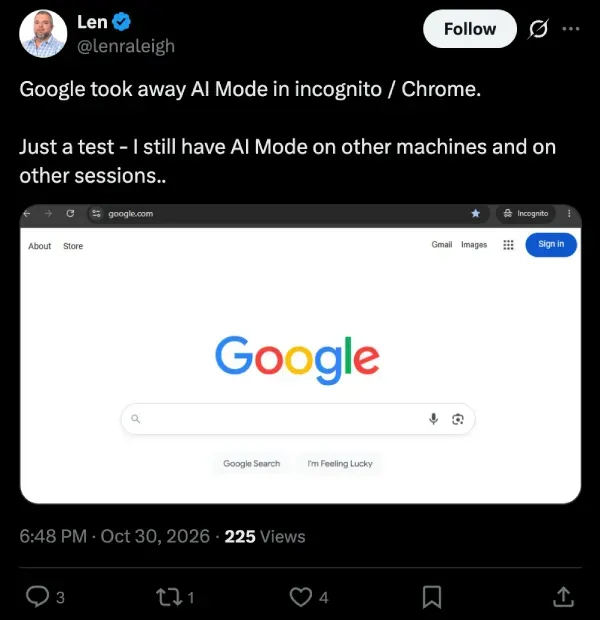
He called it “just a test,” and it’s probably routine. Still, it’s a funny contrast to tell schools Search and AI can’t be separated on the same day someone sees them separated in an Incognito window.
Is AI search hurting Google’s own business?
This is the part I find most interesting. Publishers have been saying for two years that AI Overviews eat their clicks. We covered news outlets losing up to half of their search traffic last year, and how Google rubbed salt in the wound by adding that News doesn’t drive much ad revenue for the company.
Last week, Google admitted that AI search is pinching its own revenue too. On Alphabet’s Q3 earnings call, chief business officer Philipp Schindler said “the strong growth in AI Mode queries had an impact because of the lower monetization we were seeing in AI Mode.” Search ad revenue still grew 12% to $63.3 billion, and Schindler said currency swings were the biggest reason growth slowed, not AI Mode. But investors focused on the AI line. The BBC reports Alphabet lost just over $500 billion in market value in a day.
And to no one’s surprise, Google’s response to all of this is more ads inside AI. Schindler said it is “scaling high-quality ads within AI Overviews and AI Mode,” including outside the US for the first time.
My take: this helps explain the schools decision. If Google’s future search business runs through AI answers, a generation of students using a plain, AI-free Google is not something it wants to build.
Can Google be sued over what its AI says?
In Germany, at least, a court said yes. In May, the Munich Regional Court ruled (case 26 O 869/26) that Google was responsible for AI Overviews that falsely tied two publishers to scams, and Wired reported it rejected Google’s argument that its error warnings were enough. The key point was that an AI summary isn’t just a list of other people’s links. It’s Google’s own content.
One detail most coverage missed: according to the court’s published record, Google appealed, and the two sides then settled, which makes the ruling void. So it doesn’t set a binding precedent, but the reasoning is now on the record for the next plaintiff.
What can students and parents actually do?
At the time of this writing, nothing really changes, so parents don’t need to take any immediate action. The new controls roll out early next year, and Google says schools will get details “in the coming months.” If you have a school-age kid, ask your district which option it plans to choose. That decision is about to matter more than it used to.
Outside school, there are alternatives. As I reported earlier today on our sister site PiunikaWeb, Kagi dropped its sign-up wall, so you can now run 50 searches without an account. Neither one is going to replace Google in a Chromebook classroom anytime soon, which is exactly why Google’s choice carries so much weight.
TechIssuesToday primarily focuses on publishing 'breaking' or 'exclusive' tech news. This means, we are usually the first news website on the whole Internet to highlight the topics we cover daily. So far, our stories have been picked up by many mainstream technology publications like The Verge, Macrumors, Forbes, etc. To know more, head here.



Dwayne Cubbins
1484 Posts
For nearly a decade, I've been deciphering the complexities of the tech world, with a particular passion for helping users navigate the ever-changing tech landscape. From crafting in-depth guides that unlock your phone's hidden potential to uncovering and explaining the latest bugs and glitches, I make sure you get the most out of your devices. And yes, you might occasionally find me ranting about some truly frustrating tech mishaps.


Follow Us

