



If you own a Vizio smart TV and you flipped off the setting that says it won’t watch what you watch, I have bad news. A Northeastern University lab study found that turning that toggle off did not change the traffic at all. The set kept talking to the same server in every test the researchers ran.
That sits on top of a mess we’ve already been covering: smart TVs that treat the living room like an ad panel. Last month we looked at rooted Samsung telemetry, LG’s network mapping, and owners pointing AI agents at their TVs to strip the bloat. This paper puts numbers on the part privacy guides usually hand-wave: does the opt-out actually work?
What did the researchers actually test?
The paper is Watching the Watchers, by Ilgar Mammadov, Het Rutul Joshi, Daniel J. Dubois, and David Choffnes. They ran 5,943 automated experiments on 12 TVs across the eight operating systems that make up about 95% of the U.S. smart-TV market. Each set played the same ten content types — from antenna TV and built-in free channels to Netflix, YouTube, HDMI, screen mirroring, and the idle home screen — with automatic content recognition (ACR) on, then again after opting out.
ACR captures brief audio or video snapshots of what’s on screen, creates fingerprints for them, and compares them with a library so the manufacturer or its partner can identify what you’ve watched. Most of this traffic is encrypted, so the team often couldn’t read its contents. However, they could confirm which servers became active when specific content appeared on screen.
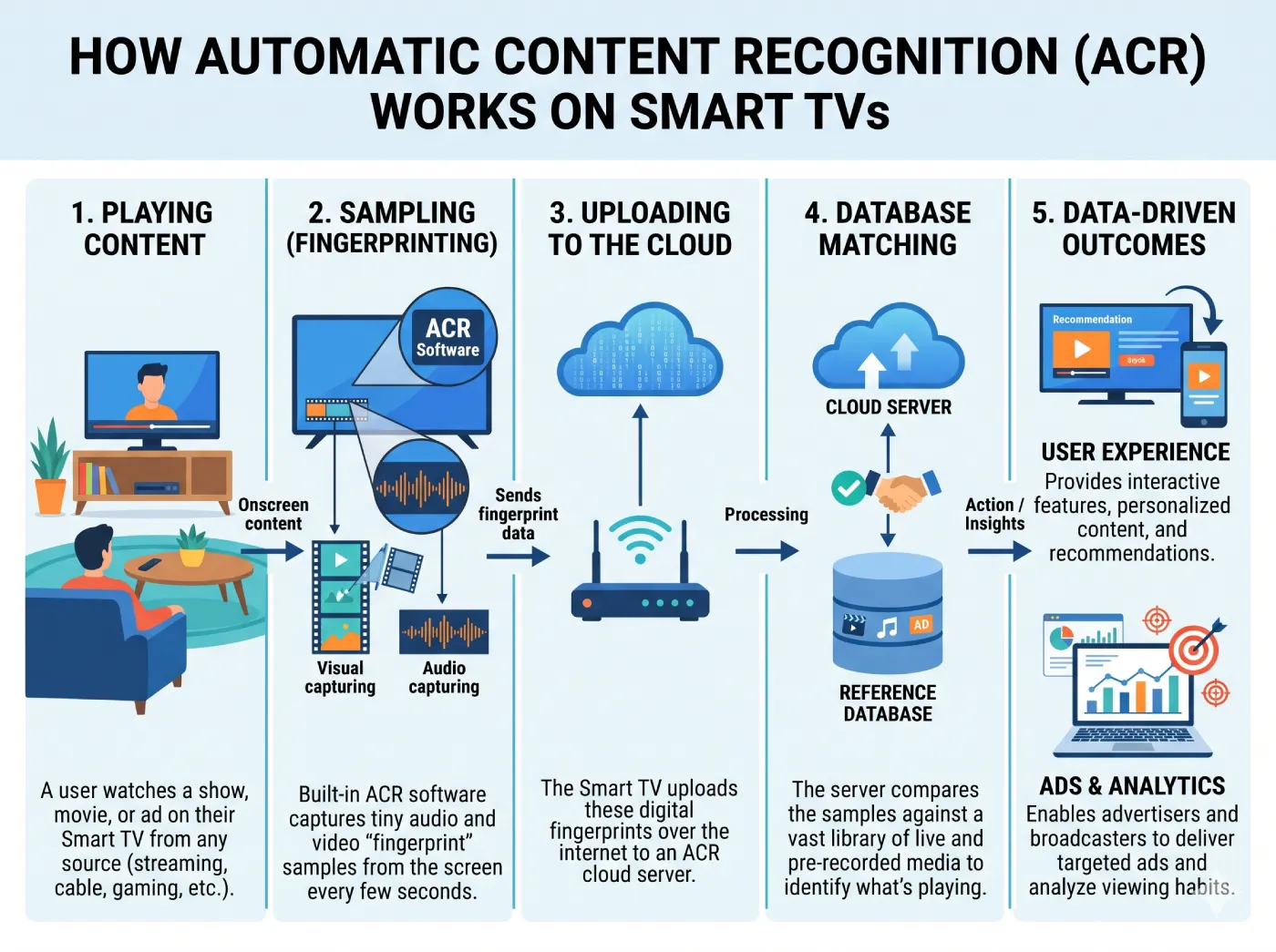
On four systems — LG’s webOS, Sony’s Google TV, Amazon Fire TV OS, and VIDAA — opting out fully stopped the ACR-linked traffic. Samsung’s Tizen cut back but still showed ACR-consistent traffic in more than 60% of scenarios. Roku’s opt-out mostly worked, except it does not cover Roku’s own free channel (TCL discloses that; Roku’s own set does not).
But when it came to Vizio’s SmartCast, let’s just say things took a turn. Traffic to an Amazon Kinesis endpoint the team tied to ACR “does not disappear or decrease in any opted-out measurement.” What this essentially means is that 100% of the opted-out runs still sent content-correlated data. The Verge reports that Walmart, which has owned Vizio since December 2024, did not comment before publication. The researchers factory-reset the Vizio and tried again. Same result. SmartCast also kept sending that ACR-pattern traffic while the TV sat idle on the home screen, in every idle run.
Haven’t we been here with Vizio before?
Yes. In 2017, Vizio paid $2.2 million to settle FTC and New Jersey charges over collecting viewing histories from 11 million smart TVs without clear consent. The order required a working opt-out. The paper identifies Kinesis traffic as the SmartCast endpoint most consistent with ACR, but stops short of alleging a decree violation because encrypted packets cannot reveal what the server does with them.
A second problem remains: Vizio’s WatchFree+ often sends show or channel names in plain-text DNS lookups to Amagi (e.g., soul-5mincrafteng-vizio.amagi.tv). Anyone between your TV and the internet can reconstruct what you watched, even with ACR off. The audited privacy policies don’t mention Amagi, and there’s no way to disable it.
What are people doing about it?
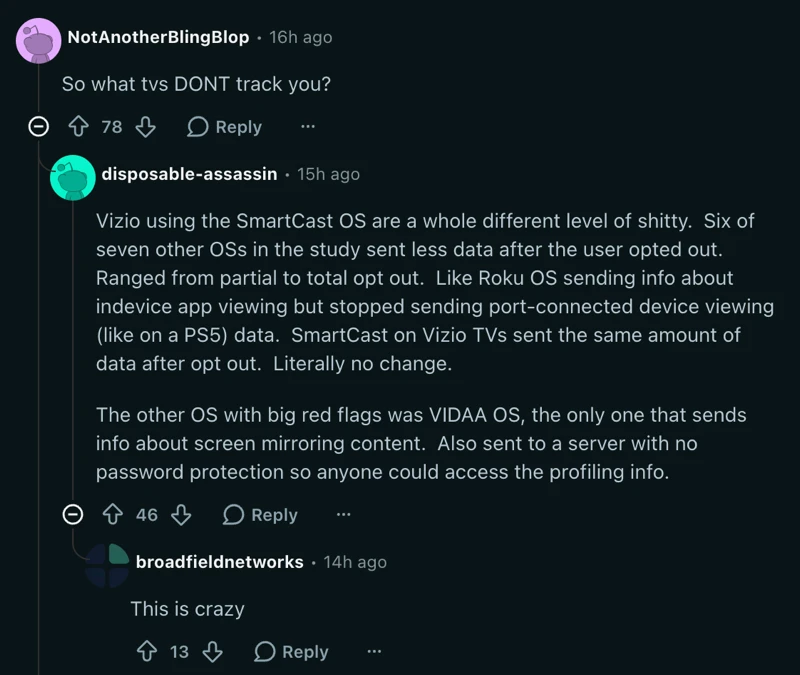
For starters, everyone’s mad, which is exactly what you’d expect. In one big thread on Reddit, a user put the study the way a lot of readers will hear it: on six of the seven systems with clear ACR traffic, opting out cut that traffic somehow; on SmartCast there was “literally no change.” That lines up with the paper once you count the partial wins on Samsung and Roku.
Now, coming to what people suggest you do. The most common advice floating around is to disconnect your TV from the internet completely. Instead, you can hook up something like an Apple TV box or another streaming device (make sure it’s trustworthy) and use that to watch what you want.
That’s also why the AI-debloat trend we wrote about earlier keeps growing. In a recent video, creator Oliur used Claude Code and Nathan Clark’s open-source CleanFrame project to put a custom home screen on his Samsung Serif — a quiet wallpaper, a handful of apps, no Smart Hub mess. When Claude refused to remap the physical Home button, he handed the job to another coding agent and finished in about an hour. That said, we’d advise caution before you let AI agents mess with your TV, since it could very well end up bricked. But it shows where owners go when the settings menu doesn’t mean what it says.
What can a Vizio owner actually do?
The paper’s advice is unglamorous and still the most reliable: keep the TV offline and watch through an external streamer that doesn’t run ACR. If you stay on SmartCast, flipping “Viewing Data” off is not enough on this evidence. The team also released an ACR endpoint blocklist for a Pi-hole or similar filter; for Vizio, they point at Inscape domains like *.tvinteractive.tv rather than the shared Amazon Kinesis hostname. Blocking Amagi cuts the WatchFree+ title leak, and it also breaks WatchFree+ itself.
I’d treat every other privacy toggle on the set the same way this study treated ACR: it’s worth turning off, but I wouldn’t rely on it until someone measures the traffic.
TechIssuesToday primarily focuses on publishing 'breaking' or 'exclusive' tech news. This means, we are usually the first news website on the whole Internet to highlight the topics we cover daily. So far, our stories have been picked up by many mainstream technology publications like The Verge, Macrumors, Forbes, etc. To know more, head here.



Dwayne Cubbins
1485 Posts
For nearly a decade, I've been deciphering the complexities of the tech world, with a particular passion for helping users navigate the ever-changing tech landscape. From crafting in-depth guides that unlock your phone's hidden potential to uncovering and explaining the latest bugs and glitches, I make sure you get the most out of your devices. And yes, you might occasionally find me ranting about some truly frustrating tech mishaps.


Follow Us

